

Practice, play and pods

Before practices and games for the UNH women’s soccer team the last few years, the captain of the 2024 Wildcats headed to the sidelines to gather and then hand out the pods that the players wore in vests to monitor their actions on the field through GPS.
It became a bit of a crossroads between sensors and superstition, a mingling of high-tech and hijinks.
“I always grabbed as many as I could and passed them out quickly,” Hewlett explains with a laugh. “I, and at least some of the kids on the team, were very superstitious. Some of my friends wouldn’t take them out of the box or from someone unless I called their name out. If they got it beforehand, they would hand it back to me and needed me to call their name.”
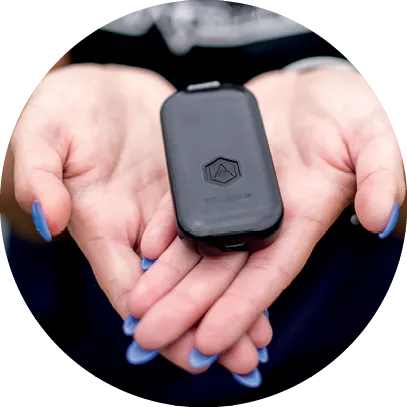
The pods collect a wide range of data. Welham focuses on elements such as distance covered, speed, acceleration and deceleration, dynamic stress load and sprints.
Hewlett, for instance, ran 7.39 miles in her midfielder position in UNH’s 3-1 victory in the America East Conference semifinal match against Binghamton in Wildcat Stadium last Nov. 7.
For players in their last year of eligibility, like Hewlett, that was their final game on their home field and was going to be their final collegiate game if they lost. The stakes were high and when Binghamton scored first, before the game was 10 minutes old, the tension increased.
“We came out slow,” Hewlett says. “After they scored, it was ‘go time.’ It was all gas and no brakes. We had to get this done or our season was over, and I remember running all over the place like a crazy person trying to get that win, and we did. I wasn’t ready for our season to be done; none of us were.”
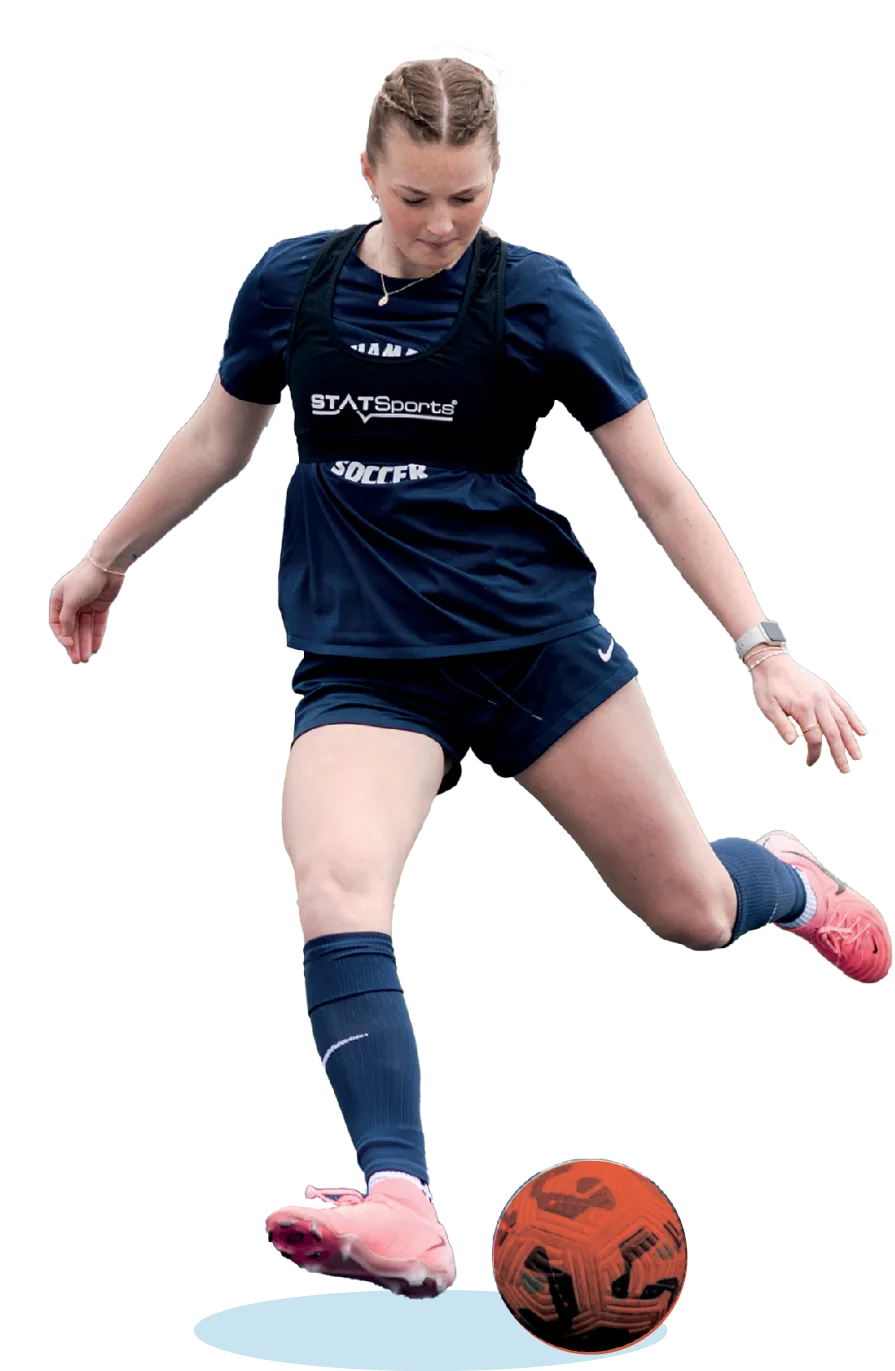
Information collected from the pods helps Welham and his staff determine how much recovery time an individual needs following a particular game or workout, for example, and leads to improving fitness and speed, along with other skills.
Welham credits Paul College instructor Peter Zaimes and participants in a sports analytics course and club he has developed — led by Charles Brissette ’25 (who begins his master’s in statistics this fall) and including McKenna Murphy ’25 — for assistance in analyzing the data.
The GPS tracks where the players are on the field and will indicate how quickly they get in and out of plays and how well a defender, for instance, closes on a player with the ball. Data is processed throughout the year with the goal of building to peak performance as the championship portion of the season approaches.
The information gleaned can be of great value, says Welham, if used wisely.
“I’m very passionate about all this and I think it has helped us,” Welham says. “But the game is still an art form. As you do more and more with it, you appreciate the science, but you have to blend the two. You can’t forget about the person and the human factor. That trumps everything. It still boils down to relationships and connections you have with the players and building that trust for them to be able to talk to you.”
Maddie Kolb ’26, named the America East Defender of the Year as a junior and the team’s captain for 2025, enjoys meeting with Welham to go over her data.
“If you feel very sore and your dynamic load number is high, it feels like you’re almost validated by the numbers,” says Kolb, an economics major. “That sounds silly, but it’s true. You need to take your recovery seriously. It holds us accountable and it helps to slow us down if we need to, which is hard to do.”
Welham hopes the proof is in another set of numbers.
The 2024 team had a 12-5-1 overall record, hitting a dozen wins for only the second time in the 40-year history of the program and first since 1988. For the first time, the Wildcats are riding a streak of three straight winning seasons. And the team has advanced to the America East championship game three times in the last four years.
“We’re proud of all that and we think the analytics has helped us,” Welham says. “A lot of things go into it. There isn’t one reason why we’ve had success. But this is a piece of the puzzle.”
Hewlett earned her bachelor’s degree in exercise science and began her pursuit of a doctor of physical therapy degree this summer at the University of Buffalo.
The Wildcats need to replace the five-year starter that Welham calls “the heart and soul of our midfield” on the field.
If that player can do double duty as the new PodMonster, all the better.