

Six Things

President
Wants You
To
Michelle
Morrissey ’97
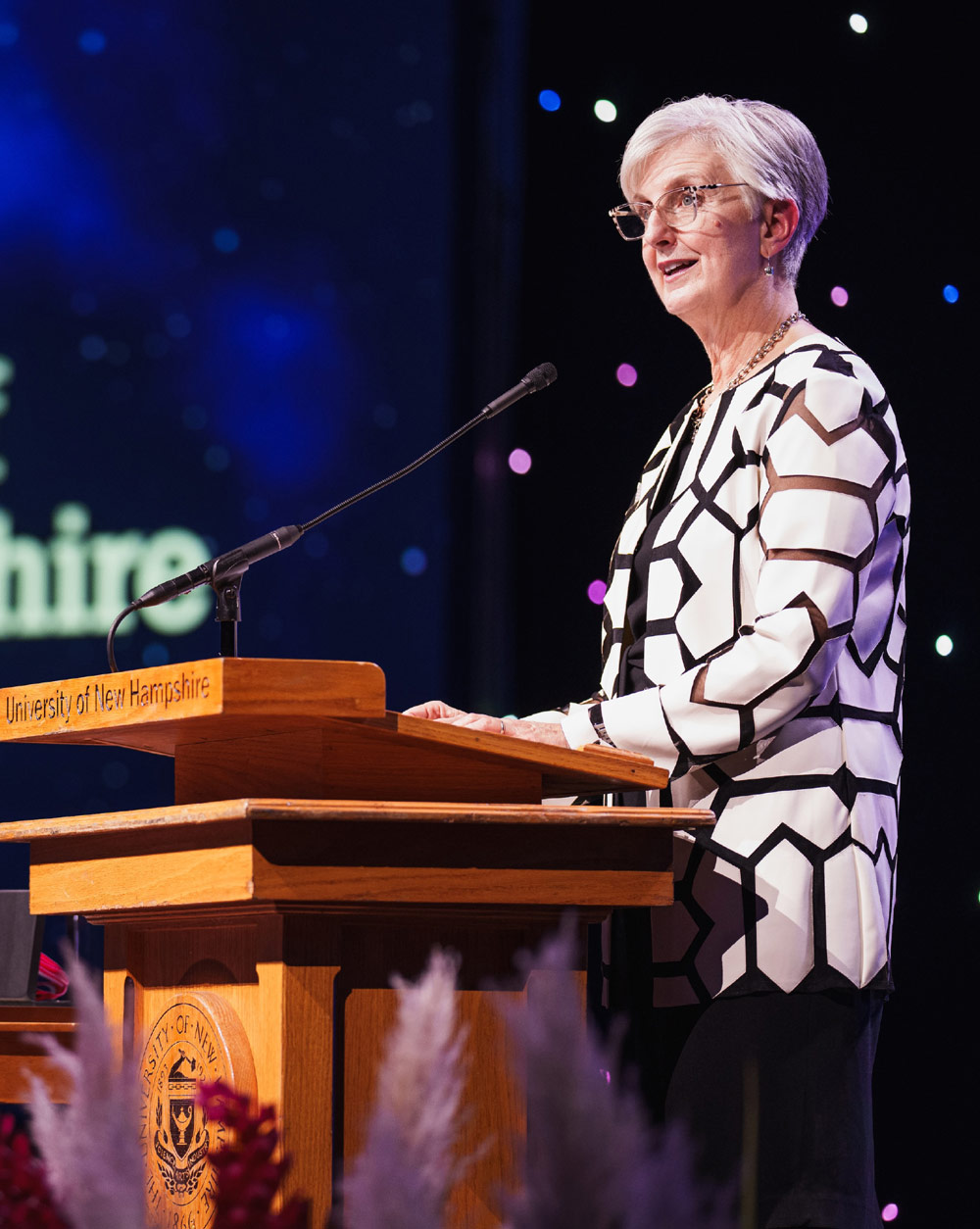
But these days, university presidents must be active leaders, not just passive listeners. And that’s just fine with Chilton, who’s been described as “a person of action and deeds.” So her first year hasn’t simply been about introductions and listening tours; it required more of her — simultaneously identifying challenges, formulating solutions, making connections, celebrating successes, and standing behind tough decisions.
Six Things
Michelle Morrissey ’97
But these days, university presidents must be active leaders, not just passive listeners. And that’s just fine with Chilton, who’s been described as “a person of action and deeds.” So her first year hasn’t simply been about introductions and listening tours; it required more of her — simultaneously identifying challenges, formulating solutions, making connections, celebrating successes, and standing behind tough decisions.
So this isn’t a story to introduce you to UNH’s newest president. After all, it’s been 14 months since she first arrived back in New England, an area she and her family know well; many readers have already gotten to talk with her — at alumni events like Reunion and Homecoming, in the dorms as you moved your son or daughter in for their freshman year last fall or at milestone events like her inauguration or Commencement 2025.
Instead, this is a story to begin to introduce you to Chilton’s vision, its roots and, even at this early stage of her UNH tenure, what she believes its impact will be. In a series of conversations with Chilton during her first year as president, it’s clear that these aren’t merely talking points or scripted messaging. These are the thoughts and beliefs of a leader with a deep faith in public higher education, who came to New Hampshire to make a difference, to learn with empathy and to lead with purpose.
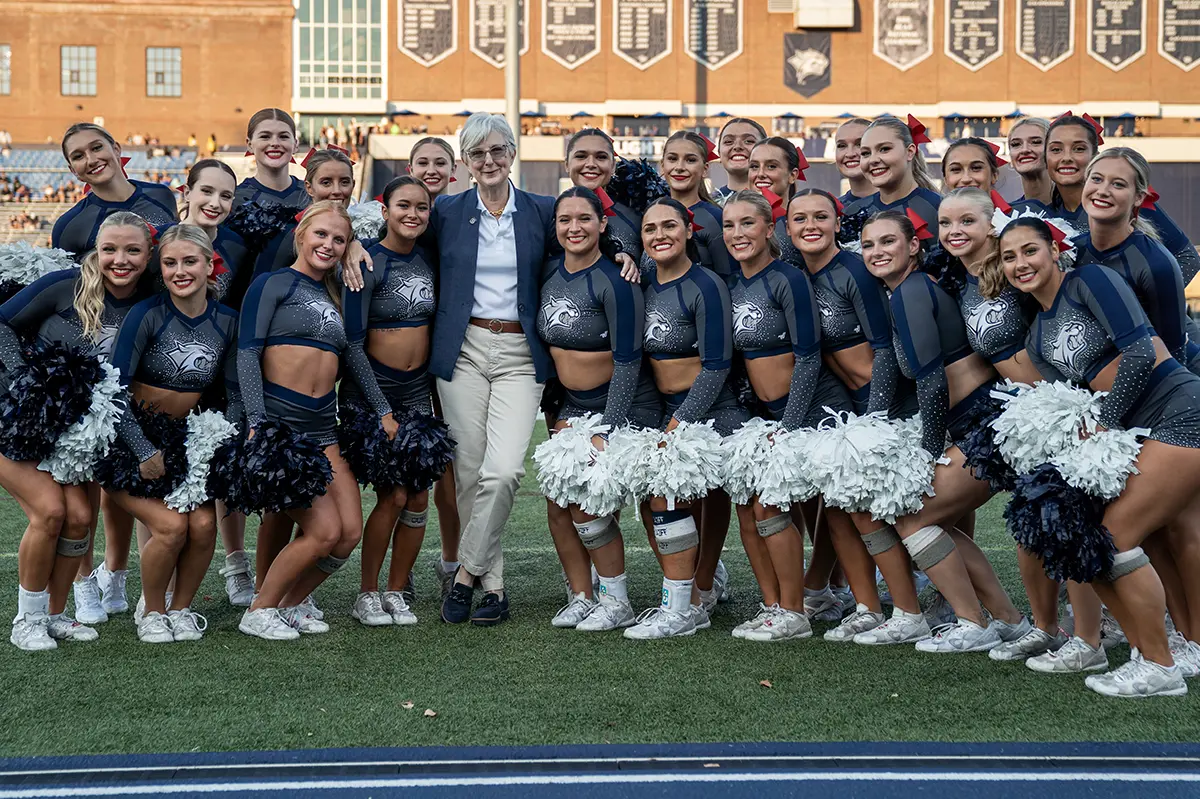
That sense of home — of community, acceptance, well-being and belonging — is as important to the college experience as a student’s academic pursuits and professional development.
Chilton believes that firmly — and was reminded of it during her first few weeks here, one sunny September afternoon.
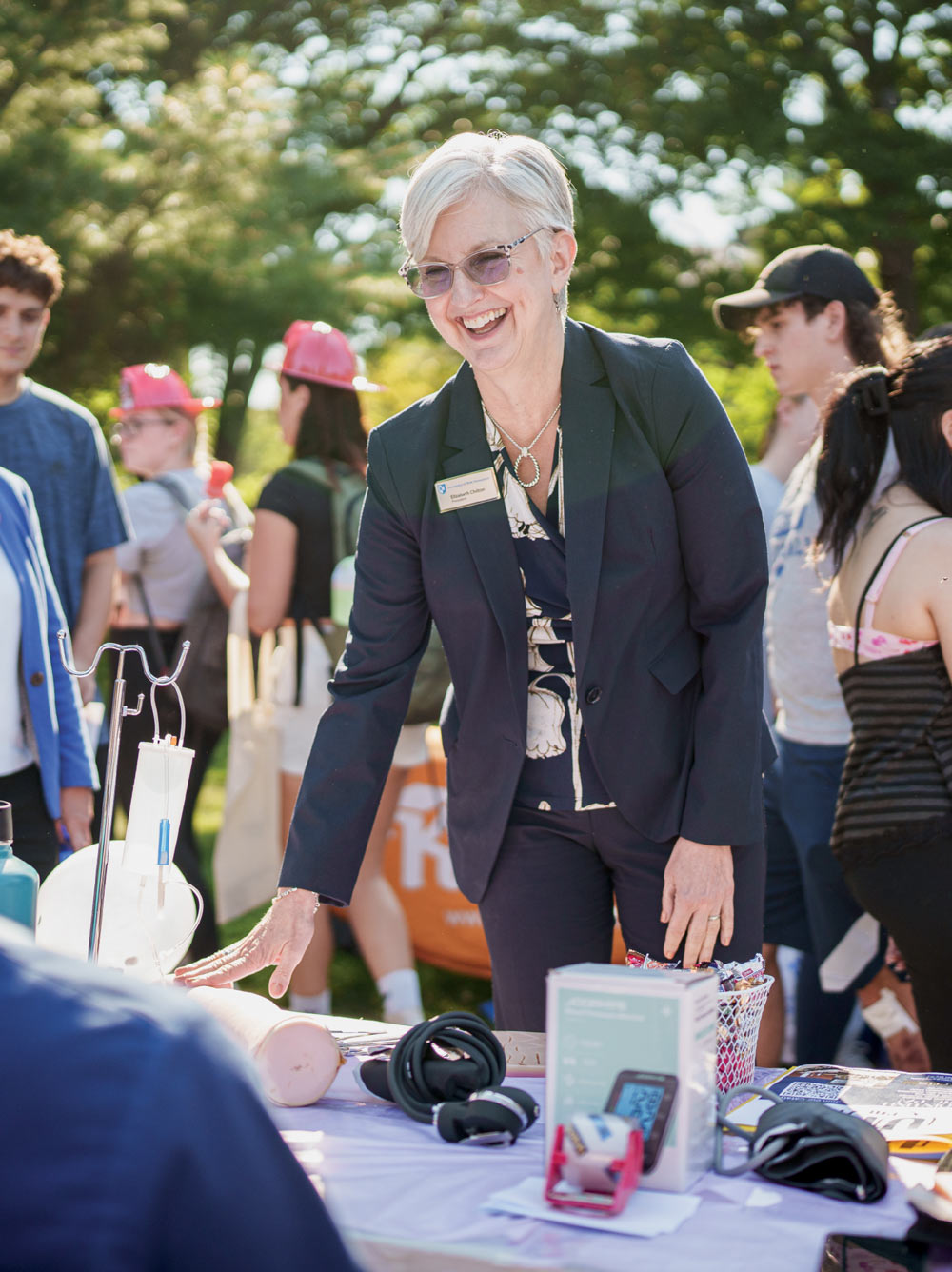
And while Chilton has been to similar events at other universities, she was struck by something remarkable about the Durham campus that day.
“I have never seen anything like that — the energy, the engagement, the excitement … the UNH students were so full of optimism and joy. And I loved seeing our faculty and staff out there, being part of the community and celebrating our students.”
That day was a strong proof point to her belief that feeling like you belong in a community is essential to both an individual student’s success and the university’s wellness. That sense of togetherness — a feeling diminished on college campuses during the height of the COVID-19 pandemic — is crucial. The need to rebuild some of that collective resiliency, says Chilton, is exactly the reason she’s putting a spotlight on this topic for UNH. It’s so important to Chilton and her leadership team that her strategic plan (set to be unveiled this fall) includes among its four pillars the idea of community — the belief that by fostering a sense of well-being and belonging among students, faculty and staff, UNH will deliver on its mission.
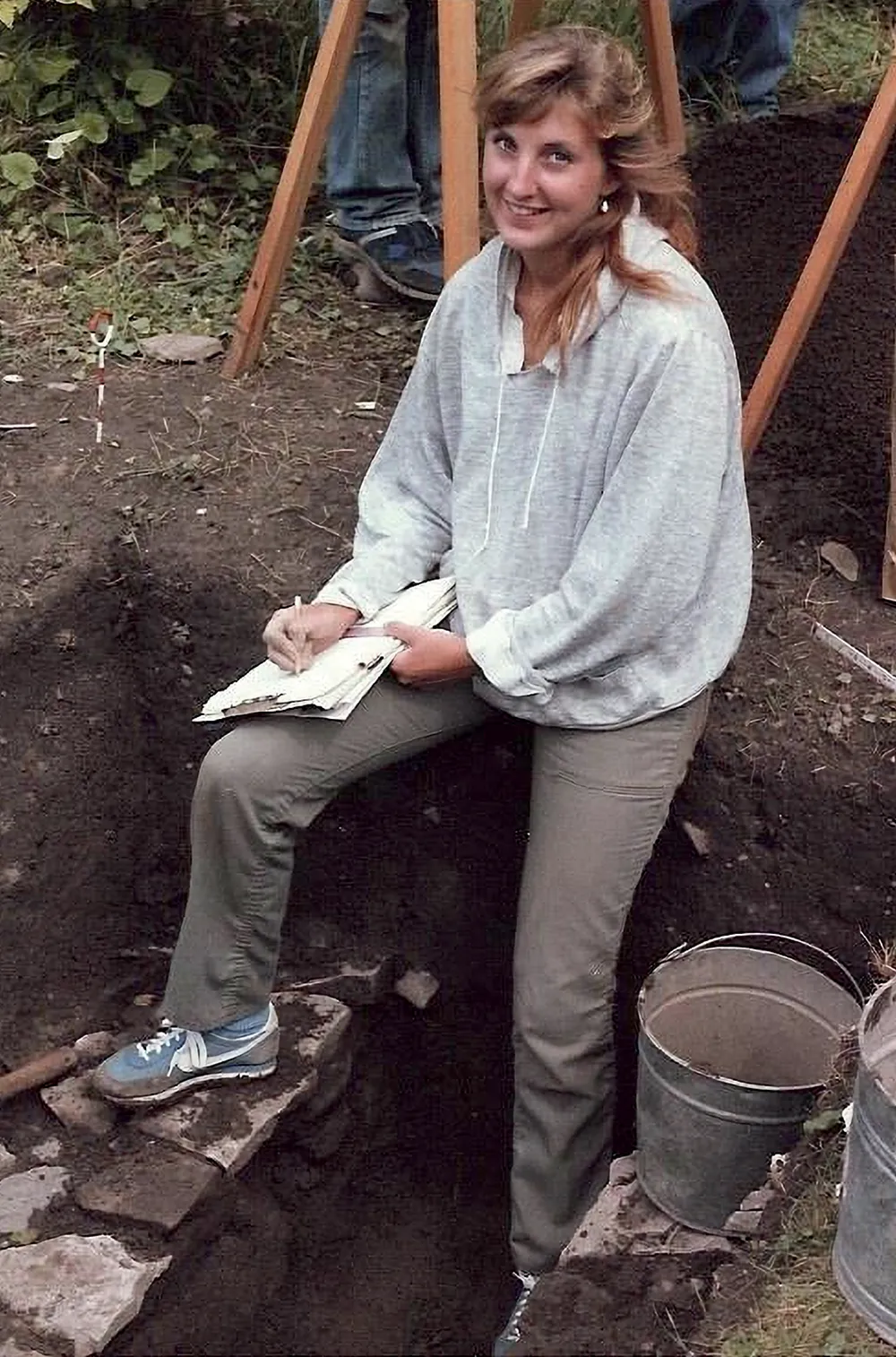
So she and her family are very much embedded in the Northeast — especially in her own archaeological research, which has focused on Native American societies in the region: “Most of my archaeological excavations have been in New York and Massachusetts,” she says.
Her resume begs the question then: Was her four-year stint from 2020 to 2024 across the country (at Washington State University as provost and executive vice president and then chancellor) just a resume blip? No — it was more like an “if not now, then when?” family decision.
“I was part of that sandwich generation, caring for my parents while caring for my own family,” from about 2005 to 2020, Chilton explains. After her parents passed, she and Michael talked about realizing their desire to live in the Northwest, after spending so much time in the Northeast. “It was a fun, exciting thing; we describe eastern Washington state as both alien and beautiful,” she says of the landscapes, climate and culture they encountered. “We really enjoyed our four years there,” but eventually decided that if the opportunity arose to return East, they’d seriously consider it.
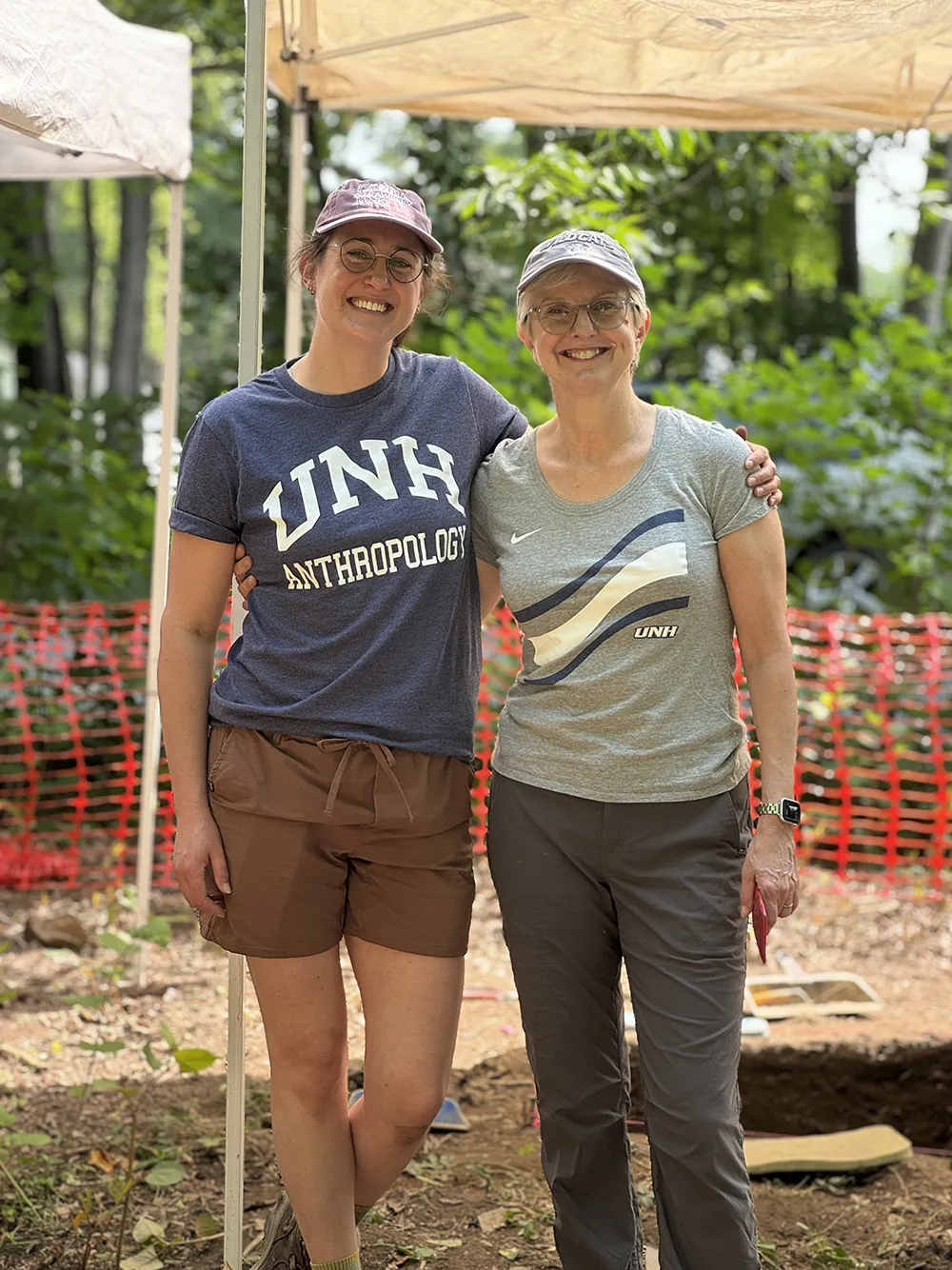
“Each place has a different culture, based on its history, its economic background, its geography, its people,” she says. “As an anthropologist, I know it’s the culture of a place that really matters, and I also know you learn the culture by talking and listening deeply.”
And so she’s spent some of her first year doing just that — attending events to meet alumni near and far, having one-on-one visits with donors and getting out across the Granite State, visiting places like Hitchiner Manufacturing, BAE Systems, Fidelity, The Boys & Girls Clubs of Greater Manchester and Sanborn Regional High School, to name a few stops on her busy calendar.
“As the state’s only public research university and with campus and extension locations in every county of New Hampshire, UNH has a large footprint, so it’s important to understand as much as possible about all of our communities so that I know how to best serve them and partner with them,” says Chilton.
First, consider the demographic challenges: there are fewer 18-to-24-year-olds in the U.S., a population trend expected to continue for the next several years in what’s being called “a demographic cliff.” There are, simply, fewer traditionally college-aged students in our population, particularly in the Northeast. Then there is the perennial challenge of state funding, which had the entire university system in statewide headlines this spring. And finally, the affordability question that families and students nationwide have been asking: Is a college degree really worth it?
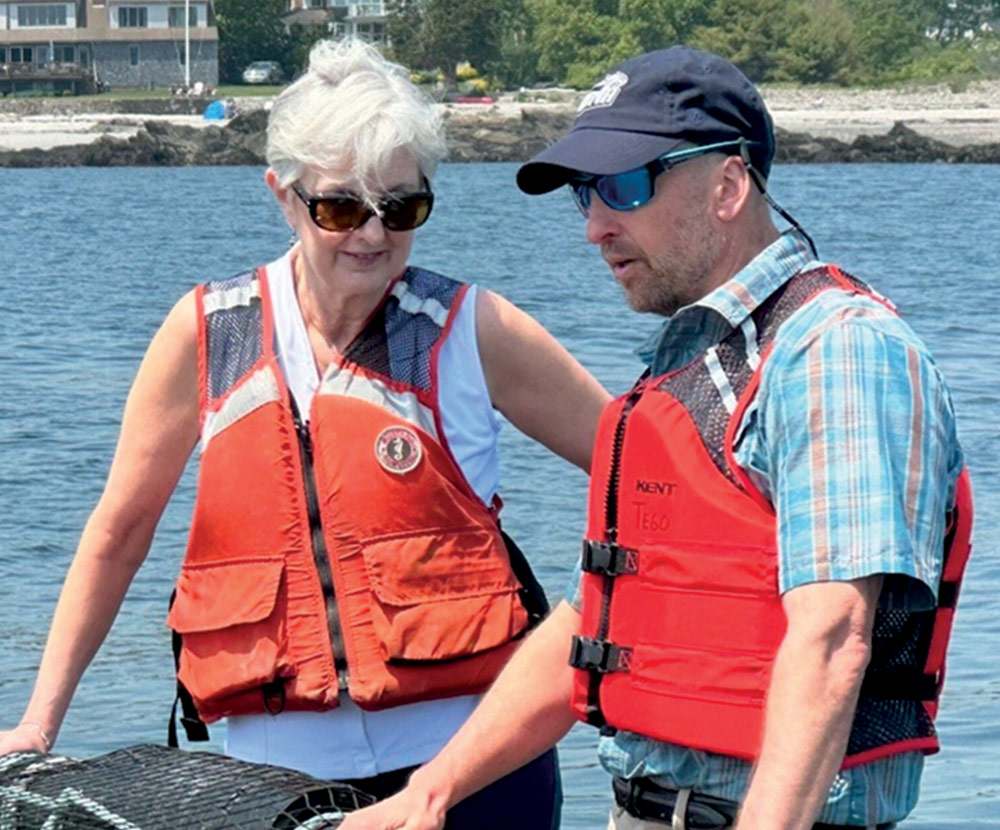
When it comes to the ROI of going to college, a troubling development has emerged, Chilton points out, based on data collected from applicants who are accepted at UNH, but ultimately choose not to enroll here: We’re not lacking for students because they want a different college experience elsewhere; they’re simply choosing not to go to college anywhere. “Our biggest competitor isn’t another college; it’s no college at all,” she says. And having fewer students on campus is concerning for UNH, a university that is highly dependent on tuition revenue.
But it’s a concern that Chilton can absolutely appreciate, based on her own experience.
When she enrolled in SUNY Albany in 1983, it cost her $900 a year — that was the total of tuition and fees.
“As a first-generation, solidly middle-class kid, and given that my parents were sending five of us to college, I was expected to wait some tables and help make up the difference between that $900 and what I needed to live on.”
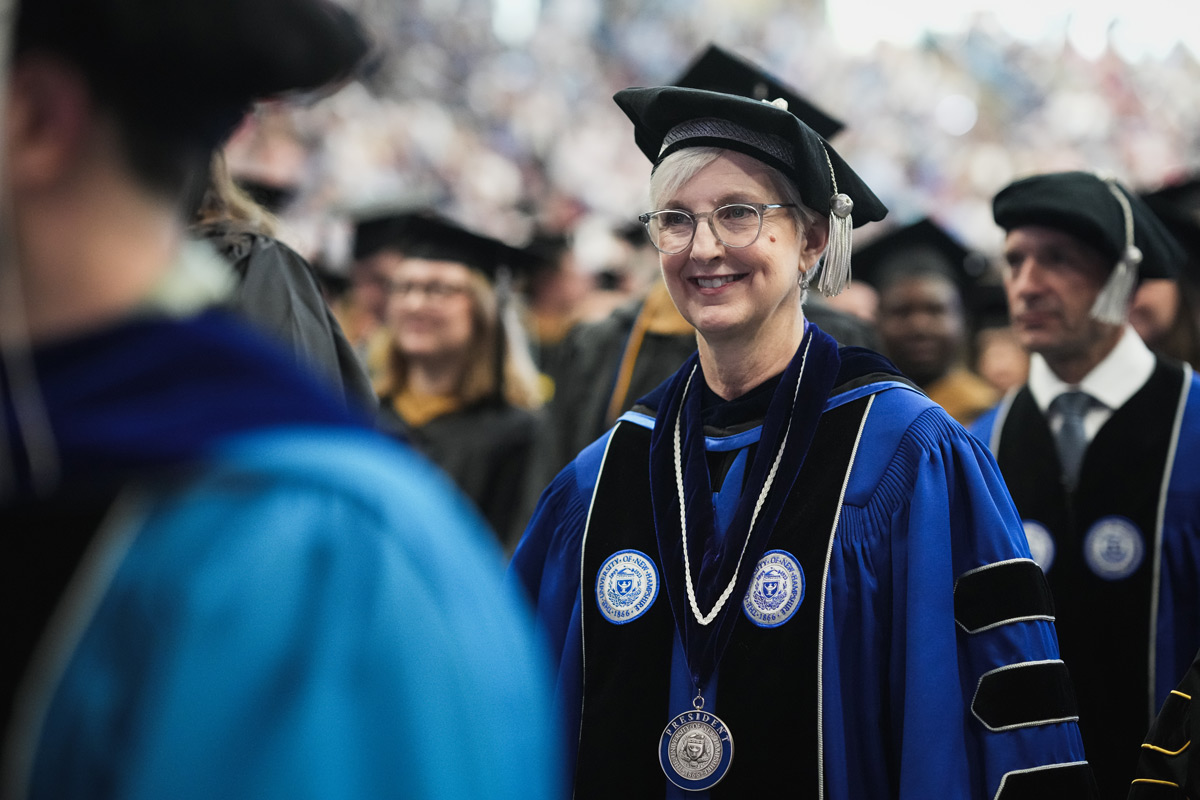
The financial question also has been part of Chilton’s leadership: in her first year, she’s begun building an executive team geared toward adopting new ways of financial management meant to work hand-in-glove with the strategic plan she’s unveiling this fall.
New administrators Aaron Howell, executive vice president of finance and administration, and Jeannette Riley ’91G, provost and executive vice president for academic affairs, were hired by Chilton with the knowledge that new approaches and innovation will be required to manage the ebbs and flows of both state support and fluctuating tuition revenue for the university.
But besides the hard numbers, Chilton’s message about the ROI of a college degree is that it’s preparing students not just for their first job, or even their career, but for the rest of their lives.
PUPPY LOVE
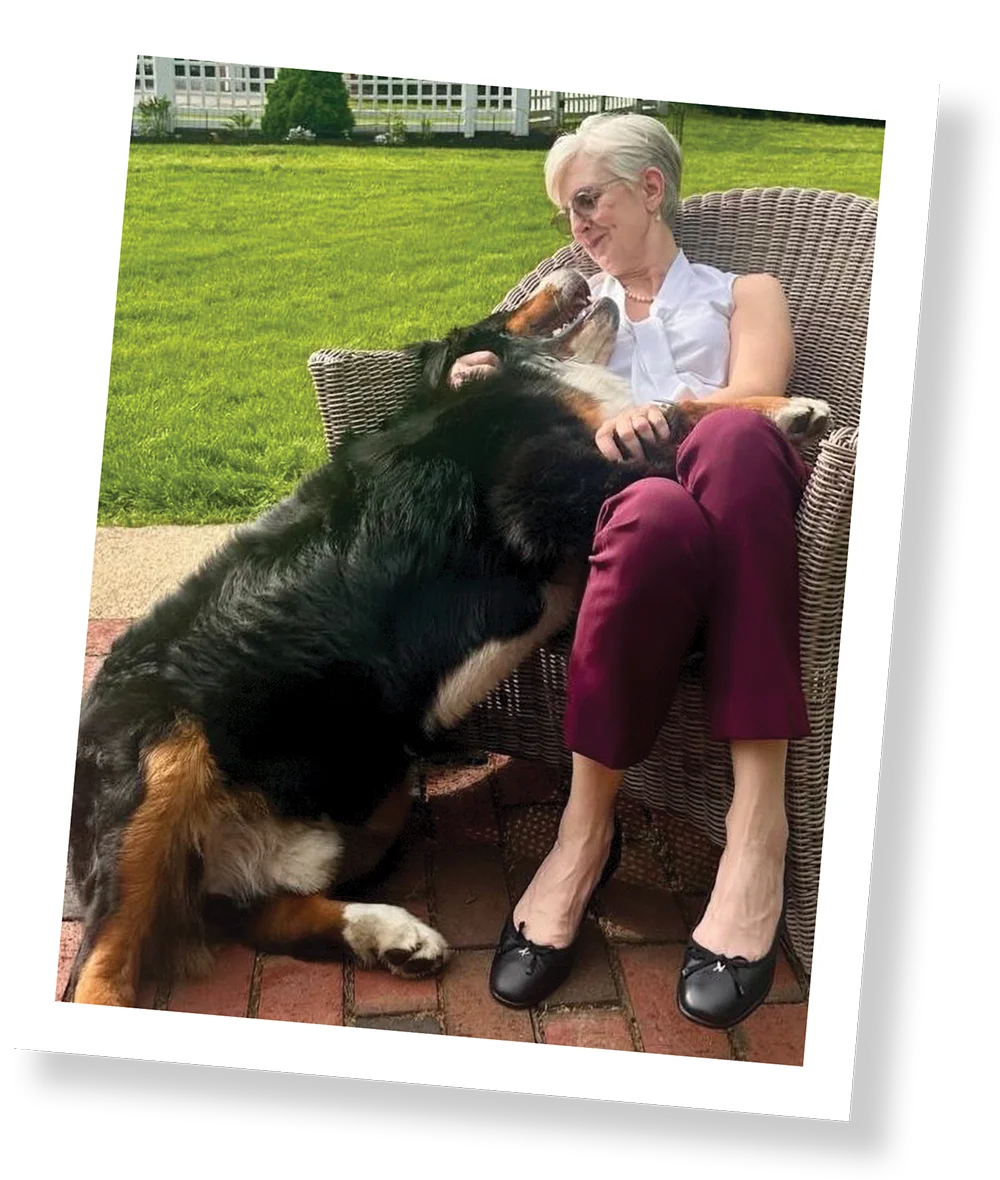
Spend a few minutes with them as they run around the backyard, eager to show oversized sticks they’ve collected, and it’s easy to see why these canines — a Bernedoodle, a Chocolate Lab and a Bernese Mountain dog — have quickly become campus favorites.
“They love being on campus; I think they’re starting to recognize students and remember, ‘Oh, you pet me last time,’ and they flop down in front of them,” Elizabeth says.
Michael, director of interdisciplinary programs for UNH Online and Continuing Education, is usually the one taking them on walks, and Elizabeth jokes that a lot of students ask him if he’s the president’s dog walker.
“He laughs and says, ‘Yes, among other things.’”
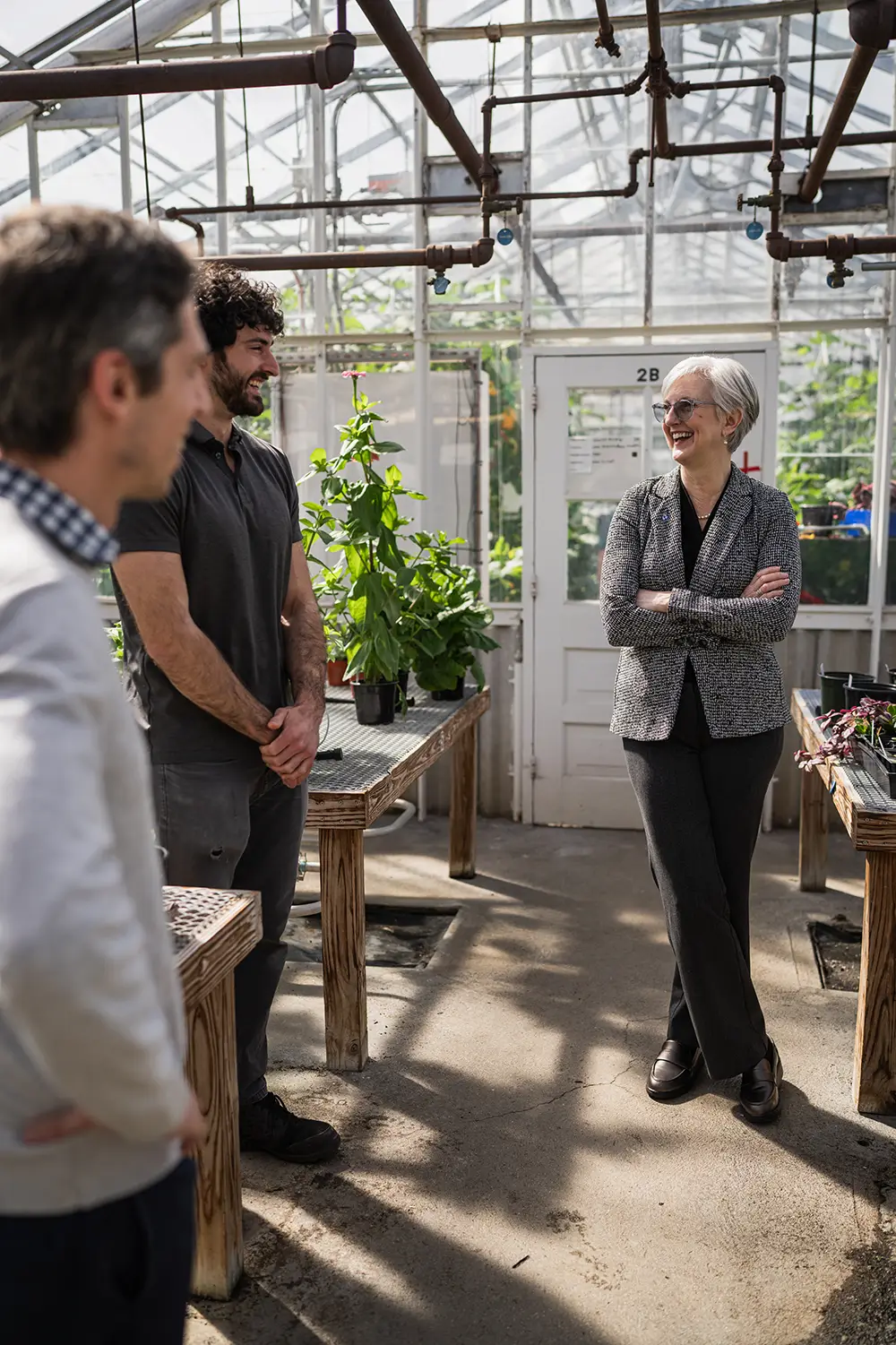
You can hear these same ideas when she’s talking to students, offering advice: make your college experience not just transactional and a means to an end; instead, embrace it as something transformative that prepares you for life. That’s part of the concept behind Chilton and her leadership team aiming to create for every student the opportunity for flexible and co-curricular academic pathways, to enhance learning across majors and disciplines, ultimately making UNH a first-choice destination for students seeking public higher education in New England and beyond.
Part of that draw is what Chilton dubs one of UNH’s “superpowers” — the research being done alongside those faculty members, not just by grad students but by undergraduates across nearly every major and discipline. When she was asked at a UNH event in Boston to describe a goal she has for UNH in just three words, she shared: ideas to impact.
“I think right now what higher education needs, and what UNH has in abundance, is our research. We don’t just study things in labs or in the field, but we take those ideas and get them out into society to solve some of the world’s greatest challenges. So a goal is to get even more of those ideas we generate out to impact communities in New Hampshire and beyond.”

Bruce Chilton had served in the U.S. Air Force during World War II on an aircraft carrier as a “radar man,” and before Elizabeth and her younger sister came along, Virginia Chilton worked as an assistant in a doctor’s office. But with a fourth and then fifth child, “she had her hands full” and became a stay-at-home mother full time.

But it was at Northport Junior High School that her journey to higher education began, as she recounted during a 2017 interview with Binghamton University.
A teacher had students write what they thought they would be doing in 10 years. “I wrote that I was going to work half-time as a telephone operator and the rest of the time I would be a mom to my three children and drive my future husband to the train station because he was going to have a high-powered job in New York City,” she recalls. It was a model she knew well from her home: her father commuted on the train every day (“complete with his business suit, briefcase and fedora hat”) and her mother raised five children and ran the household.
“My teacher gave me an A, then wrote, ‘I think you can imagine more for yourself.’ At the time I went back and forth between being insulted and being confused, and then it dawned on me that I should imagine more for myself.
“I wrote to him after I got my Ph.D. and thanked him,” she says.
That teacher may have ignited ambition in Chilton, but her own college experience wasn’t without doubt.
“As a first-generation college student myself, I understand the unique challenges of forging a path that your parents haven’t walked — navigating new situations, balancing expectations and finding yourself with so many questions that it can feel overwhelming.”
As she said on the Granite Goodness podcast earlier this year, “I thought when a professor put office hours on their syllabus that you shouldn’t disturb them during that time because I thought they were working on their books or whatever they do. It didn’t say ‘come see us,’” she told podcast host Andy DeMeo ’17. “So there’s all this coded stuff that you don’t know. You just assumed that everyone knew what they were supposed to do. And if you didn’t, you didn’t belong.”

MUSIC AS MEDITATION
She modestly — and quickly —put the rumor to rest. “Me? No, no, that’s not on the schedule, not me,” she chuckled.
While Wildcats might have enjoyed seeing her try her hand at a Broadway showstopper, audiences have been enjoying Chilton’s singing as part of the Portsmouth Pro Musica, a group of about 60 singers who rehearse once a week. The group’s most recent event was in April, when they performed “Carmina Burana” by Carl Orff.
She’s done some light opera and a bit of musical theater, but says choral ensembles are where she feels most comfortable. Chilton’s been part of a choir of some kind since the third grade. “Especially when I move to a new area, it’s a great way to get involved in the community and get to know people outside of work.”
And there’s a mental well-being side, too. “It utilizes a different part of your brain. For me, music is meditation: you’re producing something new with a group of people; it takes a certain concentration.”
She said the weekly rehearsal of a few hours leaves her feeling like she’s had a mini-vacation. Her favorite pieces to sing are Renaissance madrigals, especially those from Italy, as well as the work of Morten Lauridsen, a Washington-based composer, and a piece performed by Pro Musica, “Where the Owl Lives” by Gregory Brown (poetry by Mimi White).
Being able to put a name to that experience and those feelings was significant to Chilton at the time, and significant at UNH, where one in every five students is the first in their family to go to college.
“It’s so important to demystify what it means to be first-gen. And in every college community that I have been a part of, and now here at UNH, it’s been especially meaningful to me to help first-gen and all students find the sense of belonging I ultimately found.”
That’s similar to how Chilton feels about something she hears from time to time from people around New Hampshire about UNH — “That place is a real hidden gem.” It’s well-intentioned praise that hints at something deeper.
Jokes Chilton: “We love the ‘gem’ part; it’s the ‘hidden’ part we don’t love as much.” She says the amazing things being done by UNH students, faculty, staff and alumni — much of it to benefit the Granite State — shouldn’t be hidden; it should be widely well known. Also to be celebrated are the many ways that philanthropy makes a difference at UNH — supporting students and programs that, in turn, achieve things professionally and personally that benefit New Hampshire and communities and industries around the globe.

“We are New Hampshire’s research university, not just the University of New Hampshire,” she says. She shared some examples of this with alumni at Reunion Weekend in June: Through its research, UNH generates more than $500 million in economic impact in New Hampshire each year. “UNH’s competitive research funding grew to $252 million in fiscal year 2024, supporting nearly 1,000 projects that aim to solve problems and improve lives,” she told the audience. “And our reach goes far beyond Durham. From extension offices in every county, to the Franklin Pierce School of Law in Concord, and our Manchester campus where we’re leading the charge in regenerative manufacturing, UNH is helping power the economy, workforce and innovation ecosystem of New Hampshire.”
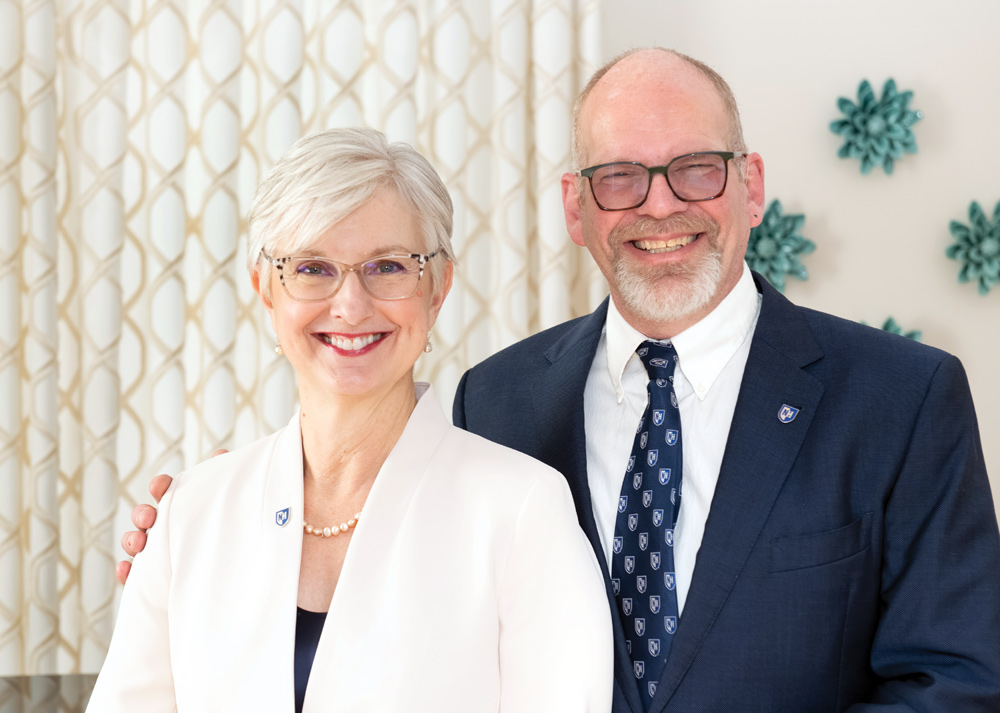
Belief in those impacts and UNH’s reach shows in the university’s strong tradition of philanthropy: This year, the university closed out a seven-year campaign with more than $365 million, exceeding its goal and proving that being “less hidden” inspires donors at all levels to invest in UNH’s students, research and programs (you can read more about the impact of this giving on pages 26-45).
“I’m a born problem solver, and in order to always be looking for the solution, you have to be an optimist because you have to believe there’s a solution to every challenge — that’s the perspective I bring.”
EVERY ‘FIRST’ IS FUN
But has she taken part in one of the most Wildcat of UNH traditions, albeit a slimy, messy one — tossing a fish on the ice after the first UNH goal at a men’s hockey game?
“Uh, not yet,” she says, in a way that shows she might be fine letting someone else handle that particular tradition. “I did get to ride the Zamboni, though!”
She likes showing her fun and funny side: “Those things are part of my personality, so I don’t think I should leave them out” when it comes to her presidency.
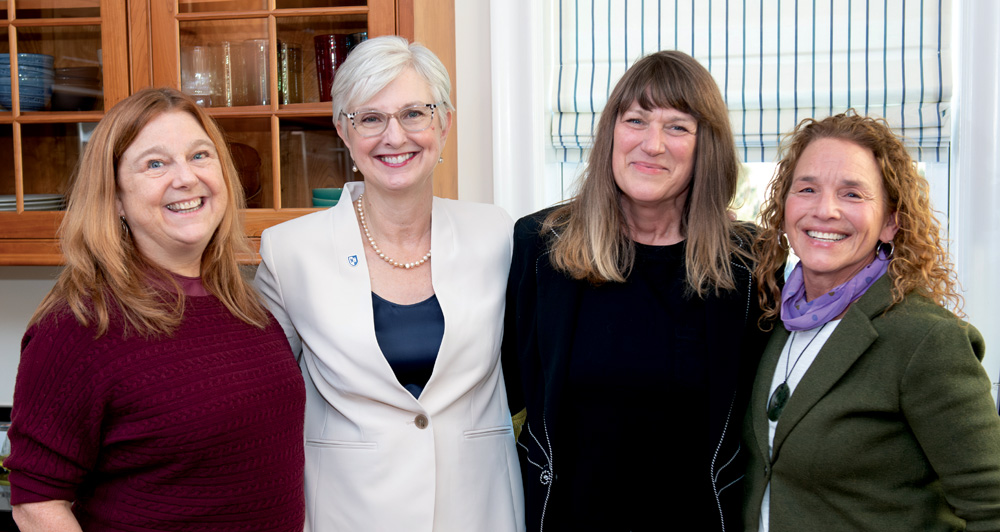
And it might have started in her Northport neighborhood as a little kid. Among the family members, friends and colleagues who were on hand for Chilton’s UNH inauguration in October, one could lay claim to knowing her the longest, aside from her siblings. That dear friend, Tara Hinrichs, met Chilton when she was 4 and Chilton was 3; they lived across the street from each other and grew up together.

Chilton, incredulous, asked her lifelong friend how that was possible.
“Don’t you remember? You used to organize all the neighborhood kids in the summertime and say, ‘OK, let’s put on a show,’ and you would write the script and design the staging and assign the roles,” her friend said.
“Gosh, I sound so bossy,” Chilton replied.
“Not at all; if you hadn’t done that, we all would have just been watching TV all summer,” said Hinrichs, with laughter.
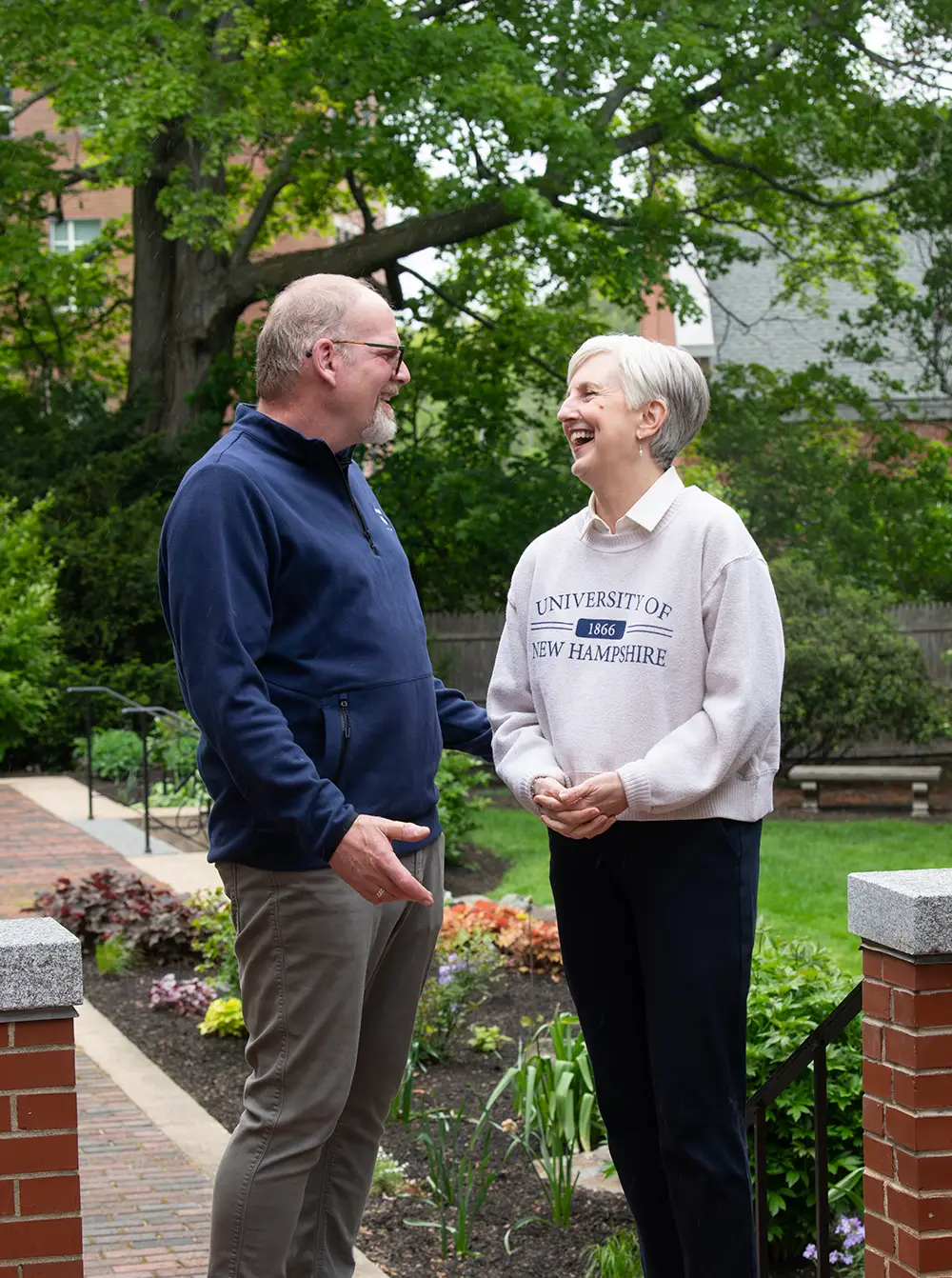
“It really brought me back to my family, my upbringing and thinking about how you got to be the person you are,” she recalls. “I miss my parents terribly, and I see elements of my dad’s driving ambition and my mother’s care and compassion that I try to embody in my approach to leadership.”
She’s on the 10-year plan at UNH — when she was hired she asked for a five-year contract, with the option to renew for a second five years, because she knew she was ready to dig in and make a difference, and she wanted to be able to realize a meaningful legacy as she guided the university into its next phase.
“I always wanted to be in a role where I’m doing something rather than being something,” she says. “I didn’t want to simply ‘be a president.’ I wanted to do something that has a positive and long-lasting impact.”