

Energy’s Next Wave: Harnessing Tides
nyone who’s surfed, swum or boated in the ocean has felt the power of its tides and waves. Now, with major funding from the U.S. Department of Energy, UNH researchers will launch a research center that seeks to harness that power as a major source of renewable energy.
The new Atlantic Marine Energy Center (AMEC), led by UNH in partnership with several East Coast universities, has been awarded $9.7 million over four years from the U.S. Department of Energy (DOE). The center will focus on research and development that could give wave and tidal power the technological boost that moves it from potential to reality. It will be one of only four National Marine Renewable Energy Centers in the country.

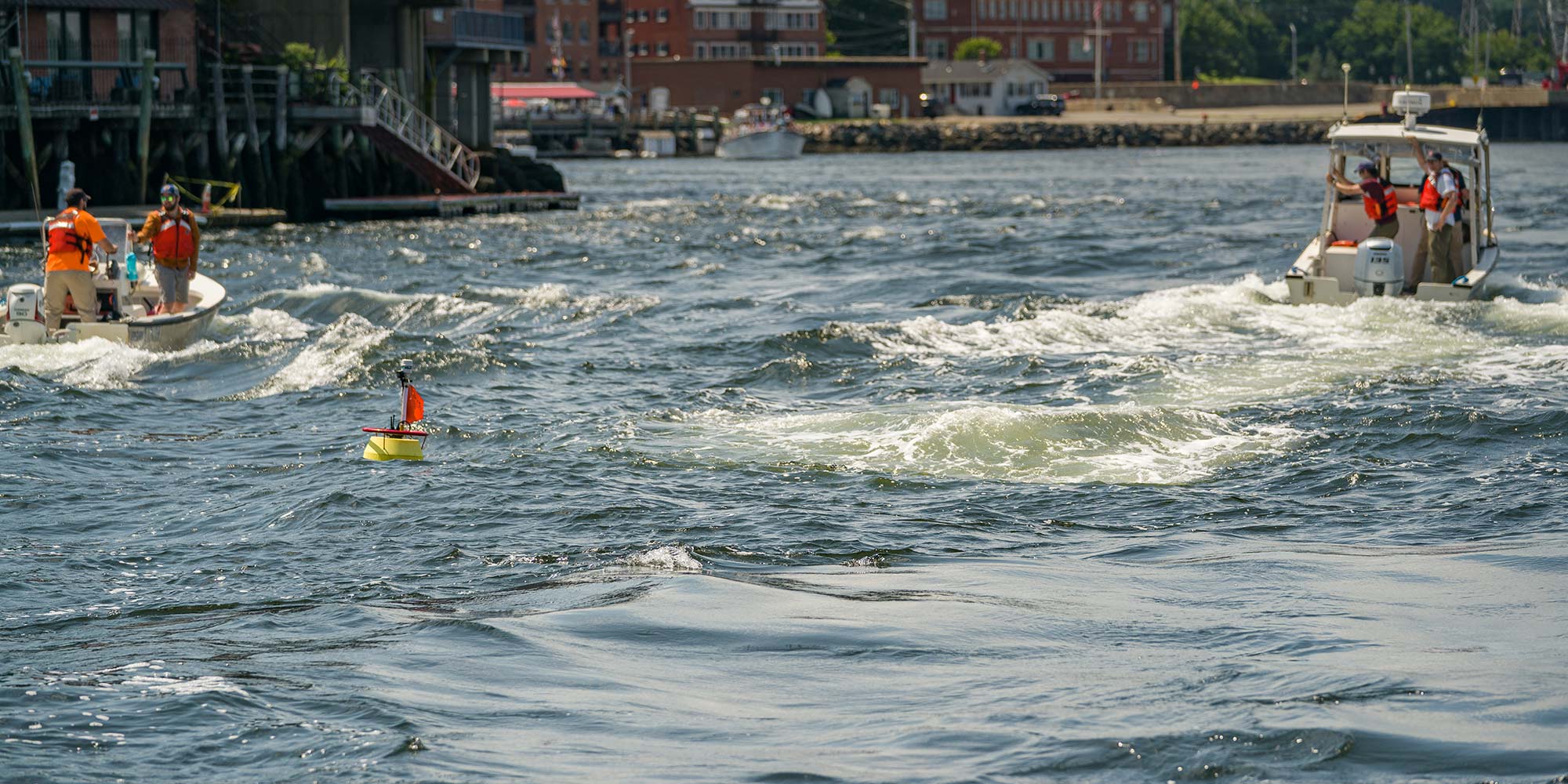
AMEC draws on the expertise Wosnik and colleagues gained with UNH’s Living Bridge project, which provides tidal energy to Portsmouth’s iconic Memorial Bridge over the Piscataqua River between New Hampshire and Maine. It will expand existing projects there, and researchers will pursue accreditation for the project to become a scaled test site for tidal energy.
AMEC joins UNH’s significant portfolio of research, addressing coastal and ocean challenges and powering the blue economy — projects that have put UNH at the forefront of marine energy research for more than a decade, says Diane Foster, director of UNH’s School of Marine Science and Ocean Engineering.
AMEC will be a consortium of academic institutions including UNH, Stony Brook University, Lehigh University and Coastal Studies Institute, which is administered by East Carolina University. The Coastal Studies Institute’s Jennette Pier project, located in the Outer Banks of North Carolina, will be developed as an accredited, scaled test site specifically for wave energy. Along with the partner universities, AMEC will also collaborate with the National Renewable Energy Laboratory, Sandia National Laboratories, Pacific Northwest National Laboratory, European Marine Energy Center and Old Dominion University.