

Honoring alumni heroes
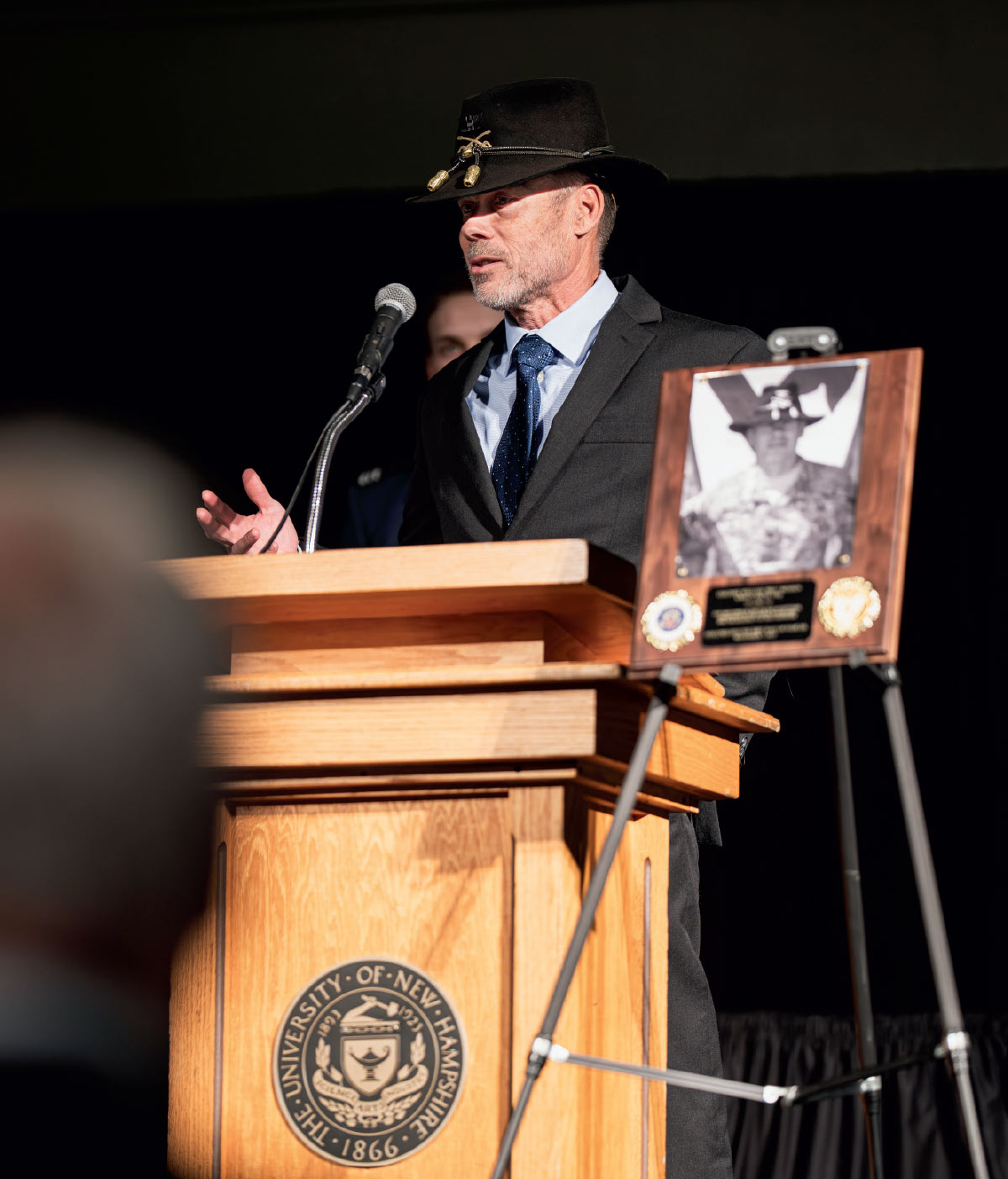
Col. William Benson ’90
As he accepted his induction into that same Hall of Fame, he shared his emotions with the audience: “I stand before you humbled … because I know the accomplishments of many of those in the audience who performed with equal or greater distinction, who performed with valor in the most difficult situations and who carry the wounds of their service. In some small way I hope I’ve recognized and honored the impact they’ve had on me, my career and my life, not to mention on the UNH community, the Army and the nation.”
Benson was commissioned through the UNH ROTC and pursued advanced military education at some of the Army’s most rigorous institutions. He held pivotal command and leadership roles, including leading the 4th Heavy Combat Brigade, 1st Cavalry Division and the 1st Squadron, 10th Cavalry Regiment, where he was responsible for commanding soldiers in complex combat areas.
He was deployed to Iraq and Afghanistan, served in Bosnia and Kosovo, and received the Legion of Merit, the Bronze Star Medal with three oak leaf clusters and the Combat Action Badge.
When he retired from active duty, he continued his work in service to others as executive director of Boots2Roots, an organization that helps active-duty military members and their families transition to civilian life. He has also been a small-business owner and an active town volunteer.
Benson shared that when he started at UNH as a freshman, it was less than a month after the funeral of his 21-year-old brother. “I wasn’t really all that interested in college. I’m not sure I would have lasted without my ROTC family. I needed to feel I belonged somewhere and I needed purpose. I found both in ROTC.”
Lt. Col. John O’Brien ’66, ’73G
In 1982, he founded O’Brien Forestry Services, through which he managed more than 30,000 acres across New Hampshire and Vermont. O’Brien and his wife, Deborah, raised three children. He died in December 2021 while working in the woods.
Lt. Col. Leander Page ’66, ’71G recalled his friend, whom he called Obi, from the days when they skipped high school to go hunting to their UNH days together, when O’Brien was known for throwing perfect spirals across the quad between Engelhardt and Hunter halls. According to Page, after O’Brien’s dedicated military service, “He became a legend in the Upper Valley in all things forestry. … He was the go-to guy after natural disasters — ice storms, floods — and he could expertly analyze the lay of the land [and] come up with a get-well plan, and he got it done.”
To the cadets, Page shared, “John had his priorities right; he led by doing and always looked out for his people first. … He was a true hero and putting him in the Hall of Fame is truly deserved. … Let his ethos help guide your careers.”
Jere Lundholm ’53
A devoted husband and father, he was also known around UNH as one of the most dedicated volunteers and supporters. His father, Carl Lundholm, was the UNH athletic director for 42 years. Jere served on the Alumni Association Board of Directors, the Athletic Director’s Advisory Board and numerous other committees. He was the first recipient of the UNH Foundation’s Volunteer of the Year Award and was inducted into the UNH Athletics Hall of Fame. Lundholm and his wife, Harriet Forkey ’54, ’67G, joined forces to create the UNH Sports Gallery Project, working for more than a decade with a committee and UNH Athletics to raise money, gather photos and collect team members’ names for the gallery, which lines the halls of the Field House. Husband and wife were honored by UNH as recipients of the 2019 Hubbard Family Award for Service to Philanthropy; they also created a scholarship at UNH to support student-athletes.
Lundholm died in June 2021, just shy of his 90th birthday. “He loved UNH, and he loved his country,” said Forkey at the event. “I am proud that Jere has received this award; on behalf of my family, thank you. I wish he could be here. … Well, I think he is now.”