

Lighting up the Skies (and Launching Student Careers)
Once at UNH, he found his way to Roger Arnoldy’s rocket research lab, which had a long history of creating space instruments to study the northern lights. There he discovered a way to combine his passion for building things with a new passion: space research.
Now a UNH physics professor with 29 rocket launches behind him, Lessard has applied his hands-on, equipment-building ethos to his own lab in Morse Hall, where undergraduates and graduate students alike have soldered wires, constructed electrical boards and tested their space instruments for numerous NASA missions. Some of them have traveled to places like Svalbard, Norway, where the northern lights are frequently on display. There, they’ve watched their years of hard work streak through the sky before collecting crucial data that illuminate the mysteries of our universe and studying space weather to help protect satellite communications and power grids.
As the university marks milestone anniversaries this year for its space science and rocket-based research, Lessard is proud of what his students have accomplished over the years. “They come in with a lot of curiosity, and I get to help with their growth in acquiring new skills and knowledge over time,” he says. “I also highly value being able to come up with an interesting science idea, create the mission that will explore it and then put the puzzle pieces — in other words, the data — together to make new discoveries.”
That legacy of discovery dates back to the 1950s, when John Lockwood, a UNH professor of physics, built the first UNH space-related instrument — a neutron monitor — which was installed on the summit of Mount Washington in an old shed in the early 1950s to record data about the high intensity of cosmic rays. The monitor, now in a more secure location on the mountain, is still collecting data.
Soon after, Laurence Cahill, who studied under renowned space-scientist James Van Allen, joined the team and built a magnetometer for NASA’s Explorer 12 mission, launched in 1961 to study the solar wind for the first time. By 1964, UNH was launching sounding to conduct studies of our atmosphere.
Cahill was one of the first federally funded researchers at UNH — he helped form the UNH Space Science Center in 1966. Faculty member Roger Arnoldy arrived the next year and established his rocket lab — the same one now run by Lessard. By 1972, UNH was participating in the first auroral rocket missions, including ASR 1 and ECHO II. In the mid-1980s, the Space Science Center relocated to Morse Hall to coincide with the formation of the UNH Institute for the Study of Earth, Oceans, and Space (EOS).
UNH’s rocket-based space research capacity doubled in 2018, when James Clemmons joined as professor of physics and astronomy. Lessard develops space plasma and UV optical instruments and magnetometers to measure electron and ion activity in the upper atmosphere; Clemmons builds instruments to measure neutral winds and turbulence — most recently for NASA’s TOMEX+ mission. The duo recently partnered on NASA’s RENU-3 mission, which studies interactions between the solar wind and the Earth’s magnetosphere.
For students like Allison Jaynes ’13Ph.D., UNH’s place on the national space-science stage has set her on a solid career path.
“UNH was a huge driver in the career I have today,” says Jaynes, who is currently director of graduate studies and associate professor in the Physics and Astronomy Department at the University of Iowa. “I gained so many contacts through UNH, and my advisor Professor Lessard in particular, that I was already part of a networking community of researchers before I even left grad school.”
Young rocketeers
A lively group of undergraduates representing a wide variety of majors meets weekly as part of the UNH Chapter of the Students for the Exploration and Discovery of Space (SEDS) club. Any student who has an interest in space science is welcome in the club — it’s not just for those majoring in the sciences.
The members design and build their own rockets that they test in a local sandpit. Their rockets typically reach an altitude of about 10,000 feet and they carry student-built equipment, which previously included a deployable water ballast and a spin-stabilized camera. This year’s design is air brakes, which rely on deployable fins to slow the rocket down on ascent and descent to help its stability and maneuverability.
Anthony Bilodeau ’26, the current president of the UNH chapter, is proud of the academic diversity of the group.
“I’m always amazed at how many students from different majors are interested in space — I used to think it was only a tightly knit, small group of people, but when you’re out there talking to people, you find out that students from all majors, all backgrounds are passionate about space science and want to build rockets.”
The SEDS club, which has been advised by professors Marc Lessard ’83 and James Clemmons over the years, also connects students with space science research opportunities, including in the two UNH rocket labs.
Rocket-science research and ready: Q&A with Allison Jaynes ’13Ph.D.
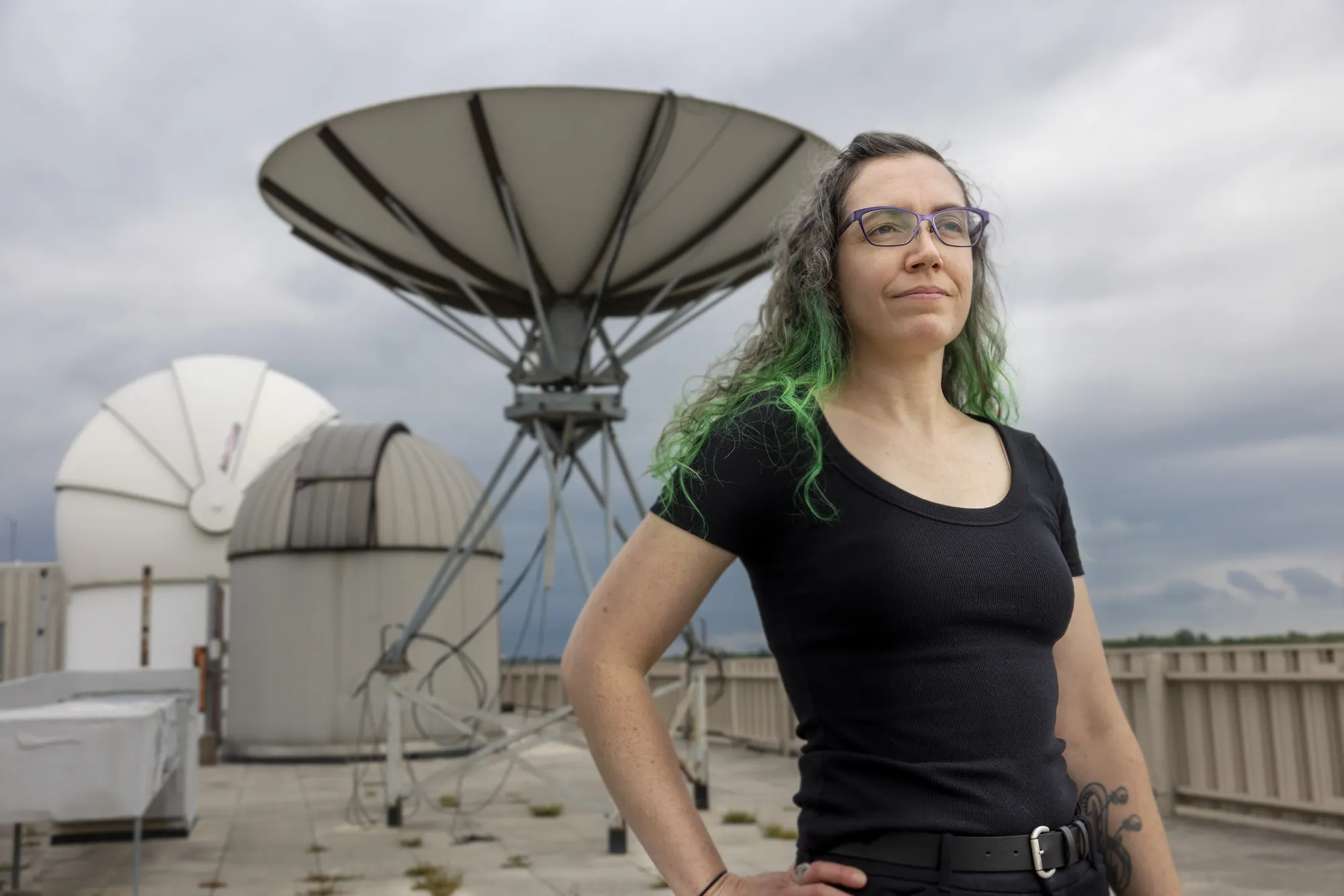
Q: What rocket mission did you work on while at UNH? What was your role in that mission?
I participated in three rocket missions. For CASCADES-2, my job was to record the auroral conditions on the northern coast of Alaska and communicate those conditions to the launch team down in Fairbanks which allowed them to make a launch decision. For RENU, I built a small instrument that measured UV light scattered from upwelling neutral oxygen over the auroral zone, and I participated in the science team launch in Norway. I also assisted with the instrument integration on the MICA rocket at the end of my Ph.D.
Q: Did you get to go to a launch? What was that experience like?
I got to go to three launches — only one of which I saw first-hand take off from the rocket pad. That was an exhilarating experience! All launch experiences are incredibly valuable in terms of learning the process and interfacing with a large team.
Q: What’s the most fascinating part of studying space science via rocketry?
The most fascinating part is knowing you are measuring data that has never been collected before and will never be collected again. Each auroral display is unique and happens just once and only once (similar to a hurricane on Earth). The really cool aspect of the rocket work is getting to study that one event in detail and then use that to extrapolate our knowledge about the space environment more generally.
Q: How has the rocket industry evolved since your time as a grad student?
The scientific sounding rocket industry has very much stayed the same! However, the commercial rocket industry has gone through unbelievable innovations. When I was a grad student, there was no such thing as reuseable rocket motors, space tourism, or swarms of CubeSats. Space access looks very different now than it did back in 2013.
Q: What was it like being part of the rocket lab at UNH?
The rocket lab was unique in that we did a lot of travel and field campaigns, which is not typical for physics labs. I traveled to both Antarctica and Svalbard (near the North Pole) for the lab work – basically the ends of the Earth! It’s exciting and also very comforting to be part of a lab like this. The intensity of the work and the time traveling makes the team very close and it starts to feel like a family away from home. I’ve also seen the most beautiful landscape and natural scenes that I could imagine, including fjords under a full moon, a whale skeleton frozen into the Arctic ocean off the coast of Alaska, and Emperor penguins just a few feet from me in Antarctica.
Q: How did UNH contribute to your career and where you are now?
UNH was a huge driver in the career I have today. I gained so many contacts through the department, and my advisor Professor Lessard in particular, that I was already part of a networking community of researchers before I even left grad school. I also gained the experience to continue on with positions involving hardware and rocket work.
Q: What’s something most people don’t know about rocket scientists?
Most people don’t think of physicists as the adventurous type, but there are many of us in this field that love that part of the work. From rocket work to geophysics campaigns measuring magnetic fields to designing rovers for distant planets, there are so many Indiana Jones moments to take advantage of!